
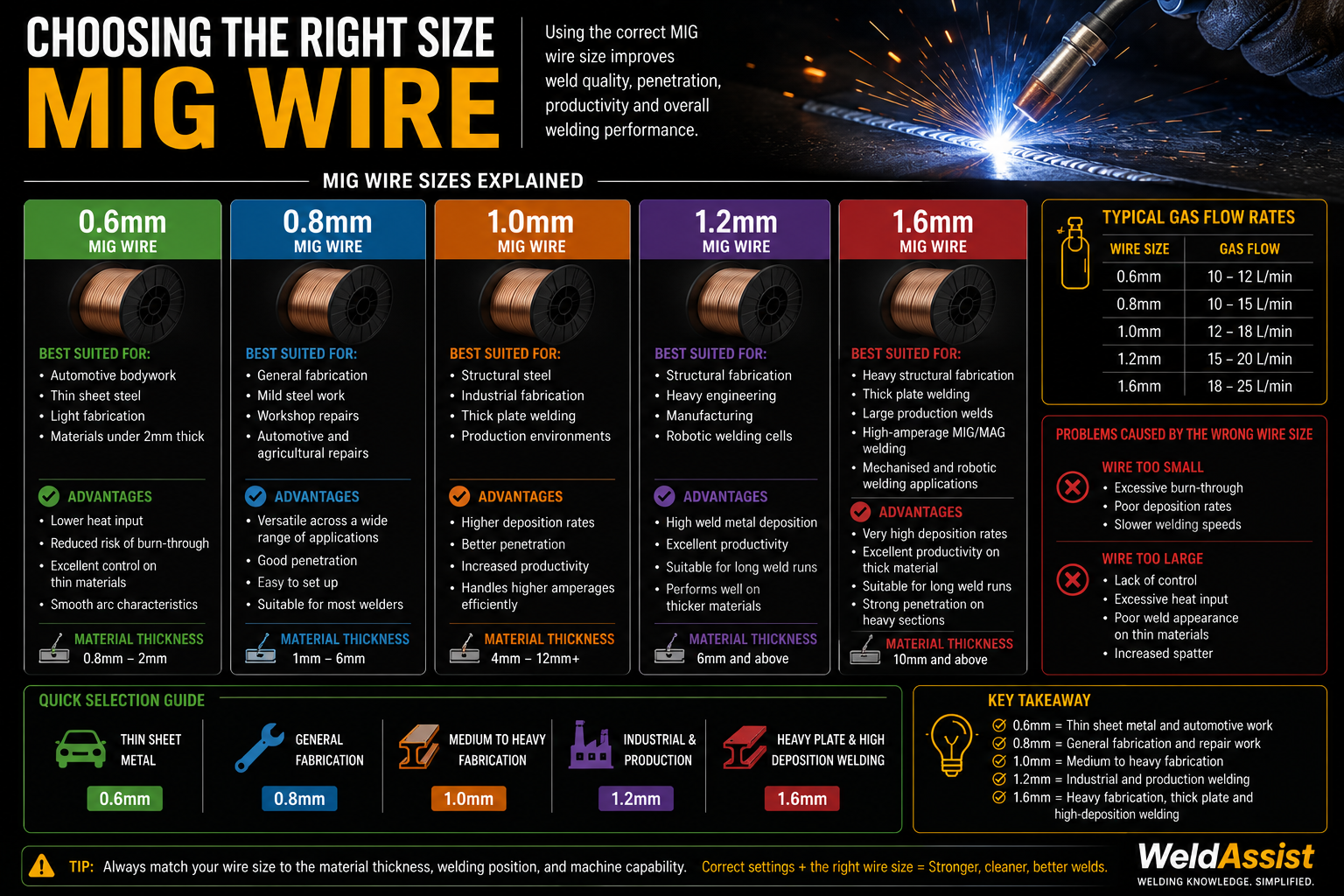
Selecting the correct MIG welding wire size is one of the most important factors in achieving strong, consistent welds. Using the wrong wire diameter can lead to poor penetration, excessive spatter, burn-through, and unnecessary frustration.
Whether you’re welding thin sheet metal, general fabrication projects, or heavy structural steel, choosing the right wire size will help improve weld quality, productivity, and overall results.
Why MIG Wire Size Matters
The diameter of the wire directly affects:
- Welding current (amperage)
- Penetration depth
- Deposition rate
- Travel speed
- Suitability for different material thicknesses
As a general rule:
- Smaller wire = better control on thin materials
- Larger wire = higher deposition rates and better performance on thicker materials
Common MIG Wire Sizes
0.6mm MIG Wire
Best suited for:
- Automotive bodywork
- Thin sheet steel
- Light fabrication
- Materials under 2mm thick
Advantages:
- Lower heat input
- Reduced risk of burn-through
- Excellent control on thin materials
- Smooth arc characteristics
Typical Material Thickness:
- 0.8mm – 2mm
0.8mm MIG Wire
The most popular all-round wire size.
Best suited for:
- General fabrication
- Mild steel work
- Workshop repairs
- Automotive and agricultural repairs
Advantages:
- Versatile across a wide range of applications
- Good penetration
- Easy to set up
- Suitable for most hobby and professional welders
Typical Material Thickness:
- 1mm – 6mm
1.0mm MIG Wire
Ideal for heavier fabrication work.
Best suited for:
- Structural steel
- Industrial fabrication
- Thick plate welding
- Production environments
Advantages:
- Higher deposition rates
- Better penetration
- Increased productivity
- Handles higher amperages efficiently
Typical Material Thickness:
- 4mm – 12mm+
1.2mm MIG Wire
Commonly used in industrial and heavy fabrication applications.
Best suited for:
- Structural fabrication
- Heavy engineering
- Manufacturing
- Robotic welding cells
Advantages:
- High weld metal deposition
- Excellent productivity
- Suitable for long weld runs
- Performs well on thicker materials
Typical Material Thickness:
- 6mm and above
1.6mm MIG Wire
1.6mm MIG wire is used for heavy-duty industrial welding where high deposition rates and deep penetration are required.
Best suited for:
- Heavy structural fabrication
- Thick plate welding
- Large production welds
- High-amperage MIG/MAG welding
- Mechanised and robotic welding applications
Advantages:
- Very high deposition rates
- Excellent productivity on thick material
- Suitable for long weld runs
- Strong penetration on heavy sections
Typical Material Thickness:
- 10mm and above
1.6mm wire is not normally used on smaller single-phase MIG welders. It requires a suitable industrial machine, correct drive rolls, heavy-duty torch setup and sufficient power output.
Which Wire Size Should You Choose?
For Thin Automotive Panels
Choose:
✅ 0.6mm wire
Provides excellent control and minimises burn-through on thin sheet metal.
For General Workshop Fabrication
Choose:
✅ 0.8mm wire
The best all-round option for most welding jobs.
For Structural Steel and Heavy Fabrication
Choose:
✅ 1.0mm wire
Offers increased penetration and faster deposition rates.
For Industrial Production and Robotic Welding
Choose:
✅ 1.2mm wire
Ideal for high-volume production and thick material applications.
Does Wire Size Affect Gas Consumption?
Yes.
Larger wire diameters generally require:
- Higher amperage
- Larger weld pools
- Greater shielding gas coverage
As wire size increases, gas flow rates may also need adjusting to maintain proper shielding.
Typical gas flow rates:Wire SizeGas Flow0.6mm10-12 L/min0.8mm10-15 L/min1.0mm12-18 L/min1.2mm15-20 L/min
Always adjust according to nozzle size, welding position, and working environment.
Common Problems Caused by the Wrong Wire Size
Wire Too Small
- Excessive burn-through
- Poor deposition rates
- Slower welding speeds
Wire Too Large
- Lack of control
- Excessive heat input
- Poor weld appearance on thin materials
- Increased spatter
Choosing the correct wire diameter helps achieve a stable arc, proper penetration, and cleaner welds.
Final Thoughts
There is no single MIG wire size that suits every application. The best choice depends on the material thickness, welding position, and productivity requirements.
For most fabrication workshops and repair work, 0.8mm wire remains the most versatile option. However, thinner materials often benefit from 0.6mm wire, while heavier structural applications are usually better suited to 1.0mm or 1.2mm wire.
Understanding when to use each wire diameter will help improve weld quality, reduce defects, and make welding more efficient.
Key Takeaway
0.6mm = Thin Sheet Metal
0.8mm = General Fabrication
1.0mm = Heavy Fabrication
1.2mm = Industrial & Production Welding
Choosing the correct wire size is one of the simplest ways to improve your MIG welding results.
Leave a Reply