
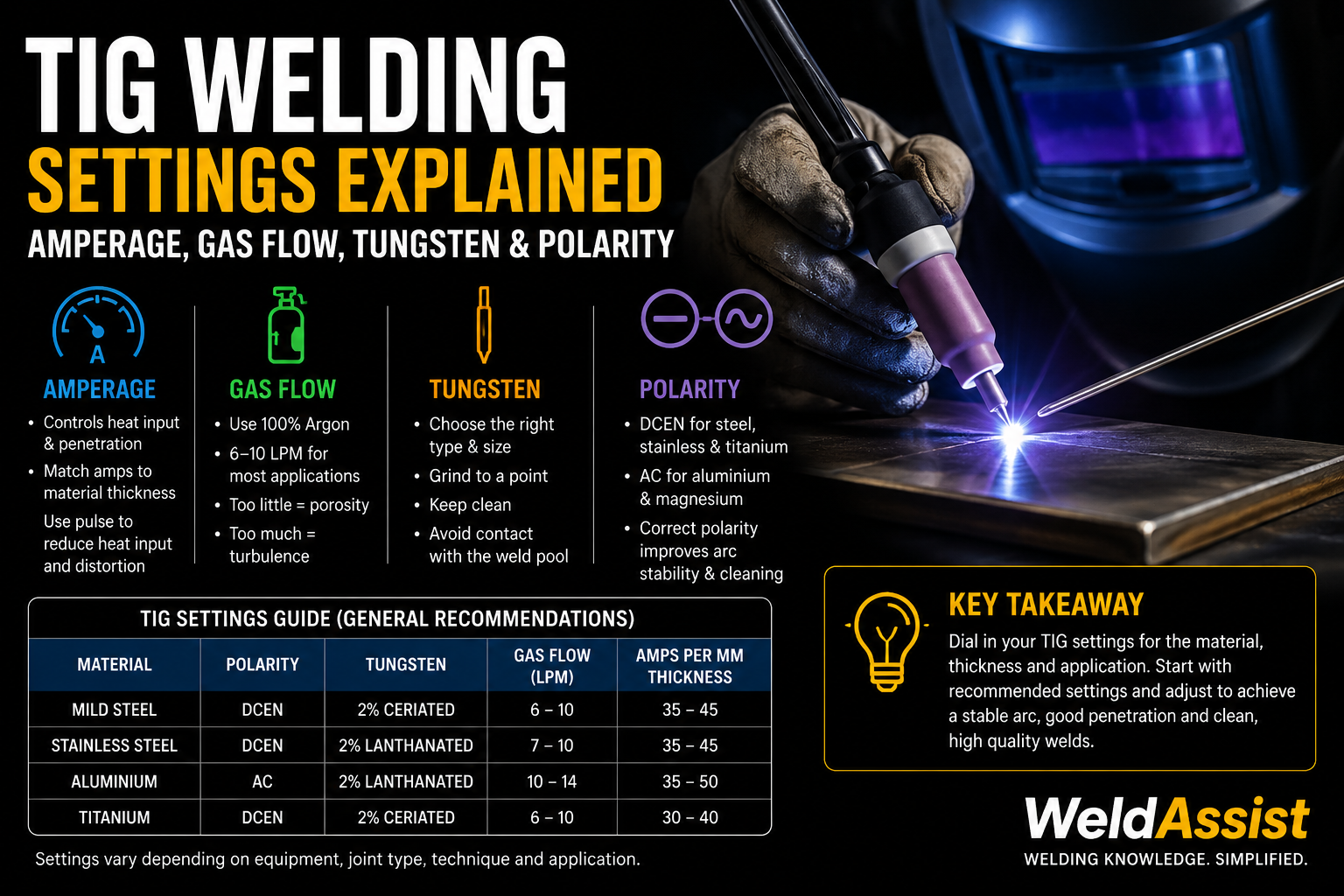
Getting your TIG welding settings right is essential for producing clean, strong and visually appealing welds. Unlike MIG welding, TIG welding gives the operator complete control over the welding process, making correct machine setup critical.
Whether you’re welding mild steel, stainless steel or aluminium, understanding amperage, gas flow, tungsten selection and polarity will help you achieve better results and avoid common welding defects.
Why TIG Welding Settings Matter
Incorrect TIG settings can lead to:
- Poor penetration
- Excessive heat distortion
- Tungsten contamination
- Porosity
- Unstable arc starts
- Excessive weld oxidation
By setting your machine correctly before striking an arc, you’ll save time and produce higher-quality welds.
1. Amperage (Welding Current)
Amperage controls the amount of heat entering the material.
As a general rule:
Material Thickness Recommended Amperage
1mm – 35-60A
2mm – 60-90A
3mm – 90-130A
5mm – 150-200A
8mm+ – 200A+
Too little amperage can result in poor fusion and lack of penetration.
Too much amperage can cause burn-through, distortion and excessive heat-affected zones.
Modern TIG welders often include pulse functions that help control heat input while maintaining penetration.
2. Shielding Gas Selection
Argon is the most commonly used shielding gas for TIG welding.
Pure Argon
Suitable for:
- Mild Steel
- Stainless Steel
- Aluminium
- Titanium
Recommended gas flow:
- Standard TIG torch: 6-10 LPM
- Large gas lens setup: 8-14 LPM
Too little gas flow can cause contamination and porosity.
Too much gas flow can create turbulence and pull oxygen into the weld area.
3. Tungsten Selection
Selecting the correct tungsten electrode is essential for arc stability and weld quality.
Grey Tungsten (2% Ceriated)
Ideal for:
- DC TIG welding
- Mild steel
- Stainless steel
Gold Tungsten (Lanthanated)
Suitable for:
- DC TIG
- AC TIG
- General-purpose applications
Green Tungsten (Pure Tungsten)
Traditionally used for aluminium AC welding but largely replaced by modern lanthanated electrodes.
4. Tungsten Size Guide
Tungsten DiameterTypical Current Range1.0mmUp to 70A1.6mm40-150A2.4mm100-250A3.2mm200-350A
Using a tungsten that is too small can cause overheating and contamination.
Using one that is too large may result in poor arc starting characteristics.
5. Polarity Selection
DCEN (Direct Current Electrode Negative)
Used for:
- Mild Steel
- Stainless Steel
- Titanium
- Most TIG applications
Provides maximum penetration and efficient heat transfer.
AC (Alternating Current)
Used for:
- Aluminium
- Magnesium
The cleaning action of AC helps remove the oxide layer found on aluminium.
6. TIG Settings for Mild Steel
Typical setup:
- Polarity: DCEN
- Gas: Pure Argon
- Tungsten: 2.4mm Gold or Grey
- Gas Flow: 8-10 LPM
- Amperage: Approximately 40A per mm thickness
Example:
3mm Mild Steel
- Amperage: 110-130A
- Gas Flow: 8-10 LPM
- Filler Rod: ER70S-2
7. TIG Settings for Stainless Steel
Typical setup:
- Polarity: DCEN
- Gas: Pure Argon
- Tungsten: 2.4mm Lanthanated
- Gas Flow: 7-10 LPM
- Filler Rod: ER308L or ER316L
Keep heat input as low as possible to minimise distortion and preserve corrosion resistance.
8. TIG Settings for Aluminium
Typical setup:
- Polarity: AC
- Gas: Pure Argon
- Tungsten: 2.4mm Lanthanated
- Gas Flow: 10-14 LPM
Example:
3mm Aluminium
- Amperage: 120-150A
- AC Balance: 65-75% EN
- AC Frequency: 80-120Hz
Common TIG Welding Problems
Porosity
Possible causes:
- Contaminated material
- Insufficient gas coverage
- Drafts affecting shielding gas
Tungsten Contamination
Possible causes:
- Touching the weld pool
- Incorrect tungsten preparation
- Excessive amperage
Poor Penetration
Possible causes:
- Low amperage
- Excessive travel speed
- Incorrect torch angle
Final Thoughts
TIG welding is often considered the most precise welding process available, but success depends heavily on correct machine setup.
Understanding amperage, shielding gas, tungsten selection and polarity will help you produce cleaner welds, improve consistency and reduce rework.
As with all welding processes, the manufacturer’s recommendations should always be used as a starting point before fine-tuning settings for your specific application.
At WeldAssist, our mission is to simplify welding knowledge and help welders quickly find the answers they need to improve weld quality and productivity.
Leave a Reply