
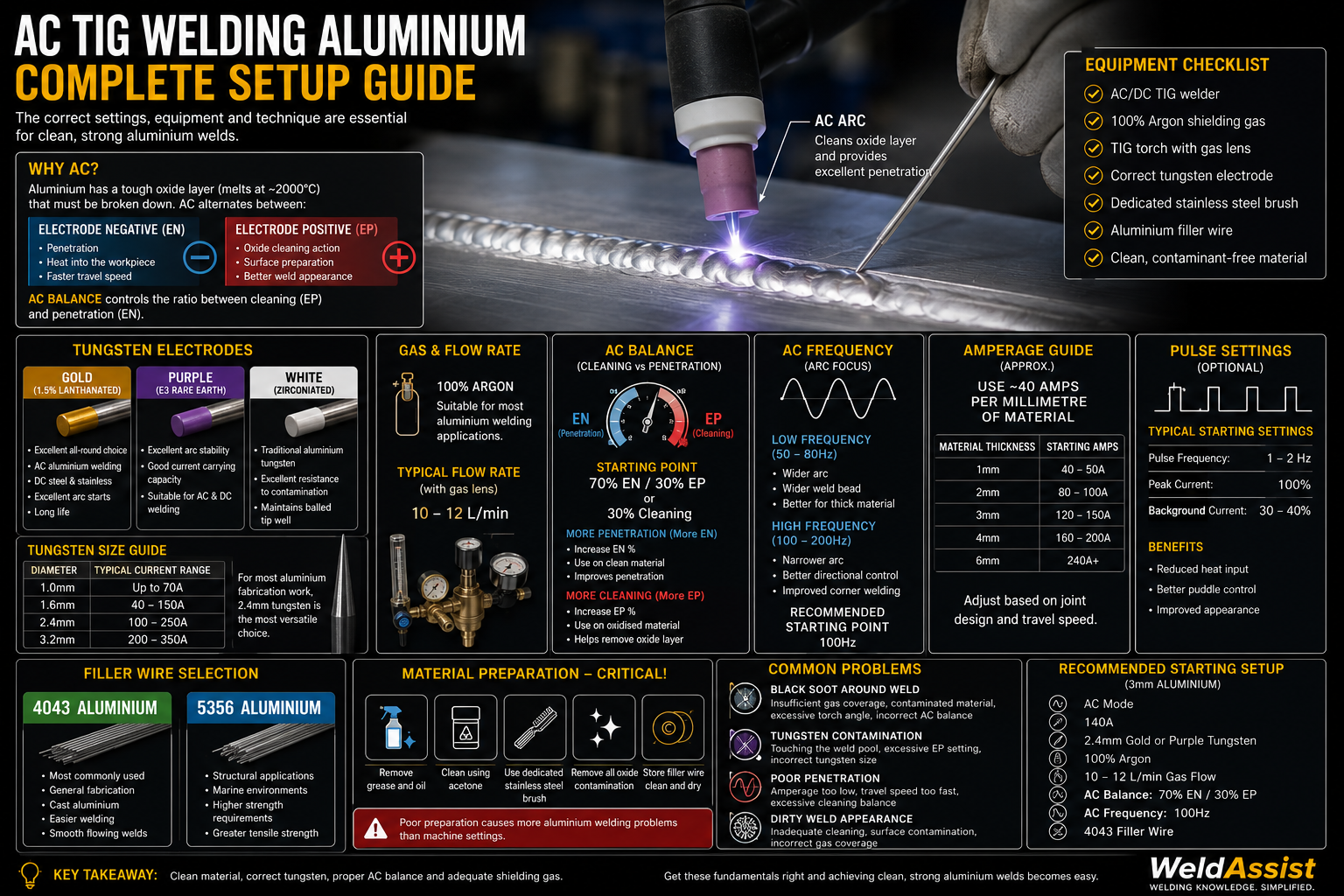
Aluminium is one of the most rewarding materials to weld, but it can also be one of the most frustrating if your TIG welder isn’t set up correctly.
Unlike steel and stainless steel, aluminium requires AC (Alternating Current) TIG welding to break through the tough oxide layer that naturally forms on the surface. Using the correct machine settings, tungsten electrode, shielding gas and preparation techniques is essential for producing clean, strong welds.
This guide explains everything you need to know to correctly set up your TIG welder for aluminium welding.
Why Aluminium Requires AC TIG Welding
Aluminium develops a layer of aluminium oxide immediately when exposed to air.
This oxide layer:
- Melts at approximately 2,000°C
- Aluminium itself melts at approximately 660°C
- Prevents proper fusion if not removed
AC TIG welding alternates between:
Electrode Negative (EN)
Provides:
- Penetration
- Heat into the workpiece
- Faster travel speeds
Electrode Positive (EP)
Provides:
- Oxide cleaning action
- Surface preparation during welding
- Better weld appearance
The balance between these two cycles creates the ideal conditions for aluminium welding.
Equipment Required
For AC TIG welding aluminium you will need:
✓ AC/DC TIG welder
✓ 100% Argon shielding gas
✓ TIG torch with gas lens
✓ Suitable tungsten electrode
✓ Dedicated stainless steel wire brush
✓ Aluminium filler wire
✓ Clean, contaminant-free material
Choosing The Correct Tungsten
Modern inverter TIG welders perform best with:
Gold (1.5% Lanthanated)
Excellent all-round choice.
Suitable for:
- AC aluminium welding
- DC steel and stainless welding
Advantages:
- Excellent arc starts
- Long life
- Stable arc
Purple (E3 Rare Earth)
Popular modern alternative.
Advantages:
- Excellent arc stability
- Good current carrying capacity
- Suitable for AC and DC welding
White (Zirconiated)
Traditional aluminium tungsten.
Advantages:
- Excellent resistance to contamination
- Maintains balled tip well
Often preferred for transformer-based TIG welders.
Tungsten Size Guide
Tungsten SizeTypical Current Range1.0mmUp to 70A1.6mm40-150A2.4mm100-250A3.2mm200-350A
For most aluminium fabrication work:
2.4mm tungsten is the most versatile choice.
Shielding Gas Selection
For most aluminium TIG welding:
100% Argon
Suitable for:
- Thin aluminium
- General fabrication
- Most workshop applications
Gas Flow Rate:
10-12 L/min with a gas lens.
Argon / Helium Mixes
Used for:
- Thick aluminium
- High production welding
Advantages:
- Increased penetration
- Faster travel speeds
More commonly found in industrial applications.
AC Balance Settings
AC Balance controls the ratio between cleaning action and penetration.
Starting Point
70% EN / 30% EP
or
30% Cleaning
This setting works well on most modern inverter TIG welders.
More Cleaning Required
Increase EP if:
- Material is heavily oxidised
- Weld appears dirty
- Black contamination forms around the weld
More Penetration Required
Increase EN if:
- Material is clean
- More penetration is required
- Tungsten overheating occurs
AC Frequency Settings
AC Frequency controls arc focus.
Lower Frequency (50-80Hz)
Produces:
- Wider arc
- Wider weld bead
- Better for thicker material
Higher Frequency (100-200Hz)
Produces:
- Narrower arc
- Better directional control
- Improved corner welding
Recommended Starting Point
100Hz
Suitable for most aluminium welding applications.
Amperage Settings
A useful guideline:
Approximately 40 Amps Per Millimetre
Examples:Material ThicknessStarting Amperage1mm40-50A2mm80-100A3mm120-150A4mm160-200A6mm240A+
Always adjust based on joint design and travel speed.
Pulse Settings (Optional)
Pulse is not essential but can improve control.
Typical starting settings:
- Pulse Frequency: 1-2Hz
- Peak Current: 100%
- Background Current: 30-40%
Benefits:
- Reduced heat input
- Better puddle control
- Improved appearance
Aluminium Filler Wire Selection
4043 Aluminium Filler
Most commonly used.
Suitable for:
- General fabrication
- Cast aluminium
- Easier welding
Produces smooth flowing welds.
5356 Aluminium Filler
Suitable for:
- Structural applications
- Marine environments
- Higher strength requirements
Provides greater tensile strength.
Material Preparation
Preparation is critical.
Before welding:
✓ Remove grease and oil
✓ Clean using acetone
✓ Use a dedicated stainless steel brush
✓ Remove all oxide contamination
✓ Store filler wire clean and dry
Poor preparation causes more aluminium welding problems than machine settings.
Common Aluminium TIG Welding Problems
Black Soot Around The Weld
Possible causes:
- Insufficient gas coverage
- Contaminated material
- Excessive torch angle
- Incorrect AC balance
Tungsten Contamination
Possible causes:
- Touching the weld pool
- Excessive EP setting
- Incorrect tungsten size
Poor Penetration
Possible causes:
- Amperage too low
- Travel speed too fast
- Excessive cleaning balance
Dirty Weld Appearance
Possible causes:
- Inadequate cleaning
- Surface contamination
- Incorrect gas coverage
Recommended Starting Setup
For welding 3mm aluminium:
- AC Mode
- 140A
- 2.4mm Gold or Purple Tungsten
- 100% Argon
- 10-12 L/min Gas Flow
- AC Balance: 70% EN
- AC Frequency: 100Hz
- 4043 Filler Wire
This setup provides an excellent starting point on most modern AC/DC TIG welders.
Key Takeaway
Successful aluminium TIG welding relies on four things:
Clean material, correct tungsten, proper AC balance and adequate shielding gas.
Get these fundamentals right and achieving clean, strong aluminium welds becomes significantly easier regardless of the machine you use.
Leave a Reply