
Many TIG welders eventually ask the same question:
Should I use a standard collet body or upgrade to a gas lens?
Both options will hold your tungsten electrode and deliver shielding gas to the weld area, but they perform very differently. Understanding the advantages and limitations of each can help improve weld quality, reduce contamination and make difficult welds much easier.
In this guide we’ll explain exactly what a collet body and gas lens do, their pros and cons, and when each should be used.
What Is a Standard Collet Body?
A standard collet body is the traditional consumable fitted into most TIG torches.
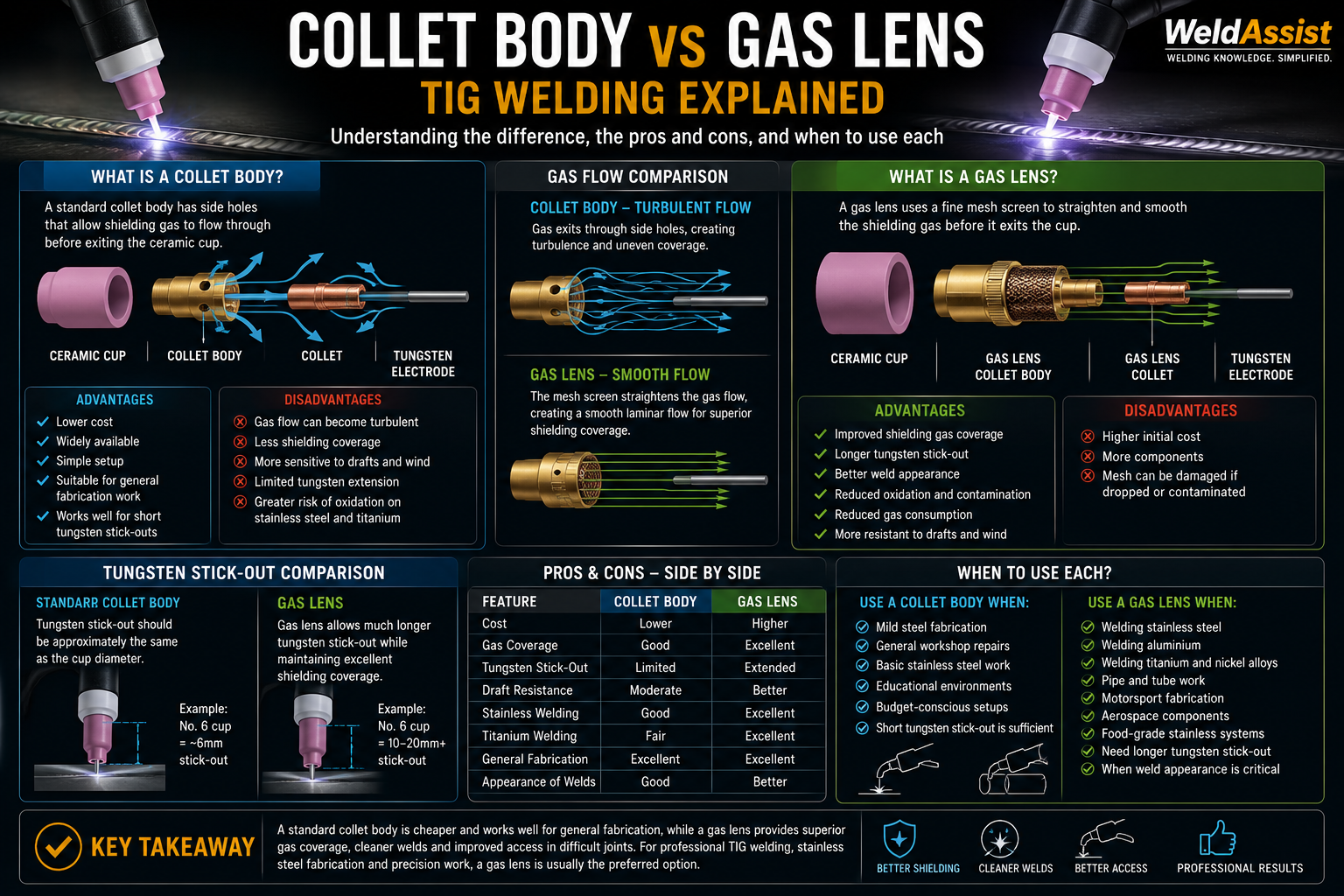
Shielding gas flows through several holes in the side of the collet body before exiting through the ceramic cup and around the tungsten electrode.
This system has been used successfully for decades and remains common throughout fabrication workshops.
Advantages of a Standard Collet Body
✔ Lower cost
✔ Widely available
✔ Simple setup
✔ Suitable for general fabrication work
✔ Works well for short tungsten stick-outs
Disadvantages of a Standard Collet Body
✖ Gas flow can become turbulent
✖ Less shielding coverage
✖ More sensitive to drafts and wind
✖ Limited tungsten extension
✖ Greater risk of oxidation when welding stainless steel and titanium
What Is a Gas Lens?
A gas lens replaces the standard collet body with a precision mesh screen assembly.
Instead of gas passing through side holes and becoming turbulent, the mesh straightens and smooths the gas flow before it exits the ceramic cup.
The result is a more uniform shielding gas envelope around the weld pool and tungsten.
Many professional TIG welders now use gas lenses as their default setup.
Advantages of a Gas Lens
Improved Shielding Gas Coverage
The smoother gas flow creates a larger protective gas envelope around the weld pool.
This reduces contamination and oxidation, particularly when welding:
- Stainless steel
- Titanium
- Nickel alloys
- Inconel
- Duplex stainless steels
Longer Tungsten Stick-Out
A gas lens allows the tungsten to protrude further from the cup while maintaining shielding coverage.
This is especially useful when:
- Welding inside corners
- Reaching into tight joints
- Pipe welding
- Tube fabrication
- Motorsport fabrication
Better Weld Appearance
The improved gas coverage often produces:
- Brighter stainless welds
- Reduced heat tint
- Cleaner weld profiles
- Better colour control
Reduced Gas Consumption
Many welders find they can achieve excellent coverage with lower gas flow rates compared to a standard collet body.
Disadvantages of a Gas Lens
Higher Initial Cost
Gas lenses cost more than standard collet bodies.
However, many welders consider the improvement in weld quality well worth the investment.
More Components
Gas lens setups often require:
- Specific gas lens collet bodies
- Gas lens collets
- Larger ceramic cups
More Fragile
The internal mesh can be damaged if dropped or contaminated with dirt and grinding dust.
Side-by-Side Comparison
FeatureStandard Collet BodyGas LensCostLowerHigherGas CoverageGoodExcellentTungsten Stick-OutLimitedExtendedDraft ResistanceModerateBetterStainless WeldingGoodExcellentTitanium WeldingFairExcellentGeneral FabricationExcellentExcellentAppearance of WeldsGoodBetter
Typical Tungsten Stick-Out
Standard Collet Body
As a general rule:
- Tungsten extension should be approximately the same as the cup diameter.
Example:
A No. 6 cup typically allows around 6mm of stick-out.
Gas Lens
A gas lens often allows:
- 10mm to 20mm tungsten stick-out
- Sometimes even more for specialist applications
This provides much better access to difficult welds.
When Should You Use a Standard Collet Body?
A standard collet body remains perfectly suitable for:
- Mild steel fabrication
- General workshop repairs
- Basic stainless steel work
- Educational environments
- Budget-conscious setups
If you’re producing good welds and don’t need extended reach, there may be no reason to change.
When Should You Use a Gas Lens?
A gas lens is usually the better choice when welding:
- Stainless steel
- Aluminium
- Titanium
- Inconel
- Pipe and tube work
- Motorsport fabrication
- Aerospace components
- Food-grade stainless systems
It’s also highly recommended whenever weld appearance is important.
WeldAssist Recommendation
For occasional TIG welding and general fabrication, a standard collet body is perfectly adequate.
However, if you’re regularly welding stainless steel, aluminium, pipework or precision fabrication projects, a gas lens is one of the most worthwhile upgrades you can make to your TIG torch.
The improved shielding, cleaner weld appearance and ability to extend the tungsten further often make difficult welds significantly easier.
For many experienced TIG welders, once they’ve switched to a gas lens, they rarely go back.
Key Takeaway
A standard collet body is cheaper and works well for general fabrication, while a gas lens provides superior gas coverage, cleaner welds and improved access in difficult joints. For professional TIG welding, stainless steel fabrication and precision work, a gas lens is usually the preferred option.
Leave a Reply