
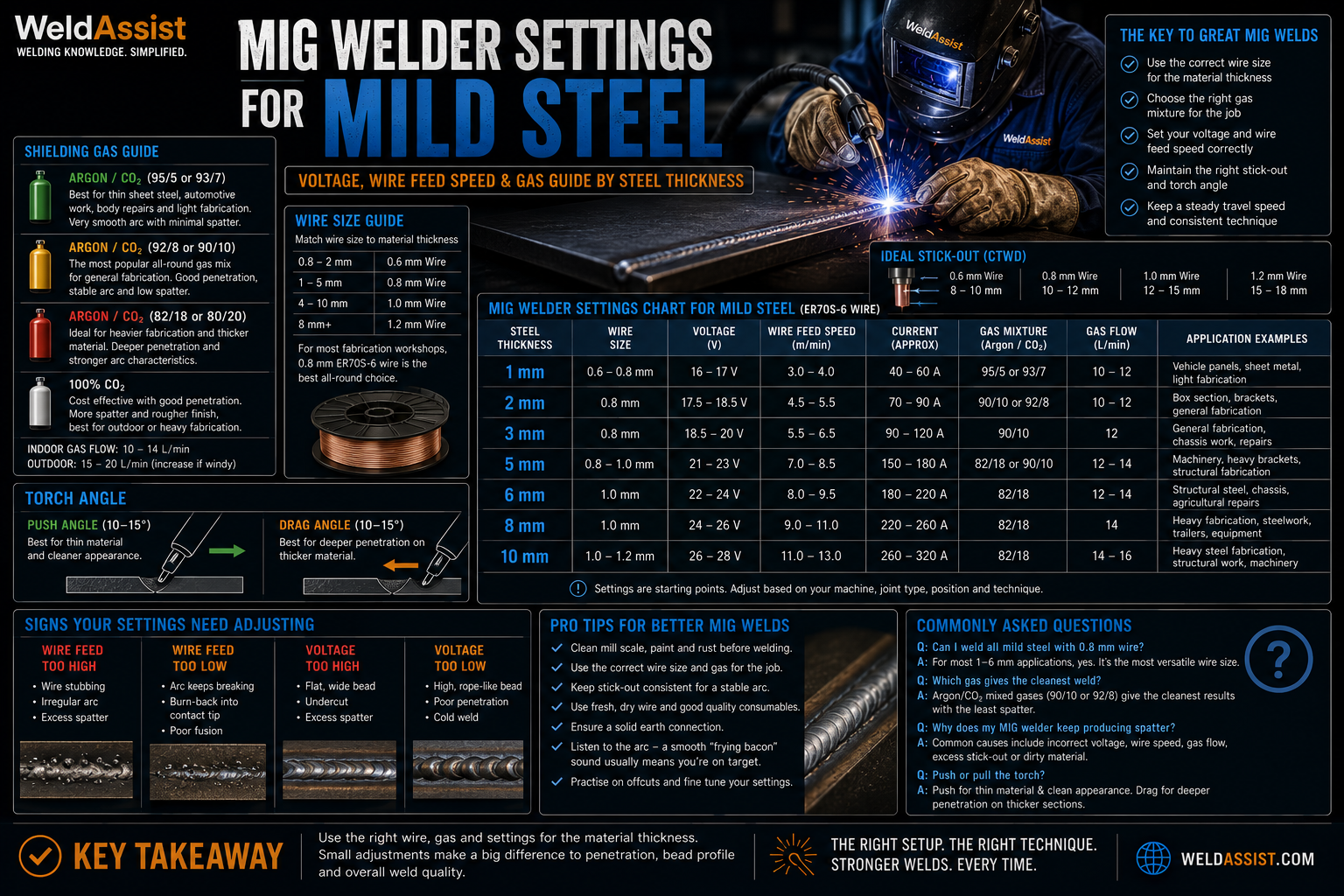
The Complete Guide to Voltage, Wire Feed Speed, Shielding Gas and Setup Charts
One of the most common questions asked by beginner and experienced welders alike is:
“What MIG welder settings should I use for mild steel?”
Getting the correct voltage, wire feed speed and shielding gas is essential for producing strong, clean welds. Too much voltage can lead to undercut and burn-through, while too little results in poor penetration and an unstable arc.
In this guide, we’ll explain exactly how to set up your MIG welder for different thicknesses of mild steel, which shielding gases to use, recommended wire sizes and common mistakes to avoid.
Important: Every MIG welder is different. The settings below are proven starting points that may require slight adjustment depending on your machine, wire brand, gas mixture, joint type and welding position.
Choosing the Right Shielding Gas
The shielding gas has a huge influence on weld quality, penetration and spatter.
Argon / CO₂ Mix (95/5 or 93/7)
Best for:
- Thin sheet steel
- Automotive work
- Body repairs
- Light fabrication
Benefits:
- Extremely smooth arc
- Very low spatter
- Excellent appearance
- Easy to control
Argon / CO₂ (92/8 or 90/10)
One of the most popular choices for general fabrication.
Ideal for:
- Gates
- Railings
- General engineering
- Workshop fabrication
Benefits:
- Excellent penetration
- Stable arc
- Low spatter
- Excellent all-round gas
Argon / CO₂ (82/18 or 80/20)
A favourite for heavier fabrication.
Suitable for:
- Structural work
- Agricultural repairs
- Heavy engineering
- Thick plate
Benefits:
- Deep penetration
- Strong arc characteristics
- Excellent productivity
100% CO₂
Still widely used due to its low cost.
Advantages:
- Cheapest gas
- Excellent penetration
- Suitable for outdoor work
Disadvantages:
- More spatter
- Rougher weld appearance
- Less stable arc
Generally, mixed argon gases provide a cleaner finish for most workshop applications.
Choosing the Correct Wire Size
Steel Thickness/Recommended Wire
0.8–2 mm – 0.6 mm
1–5 mm – 0.8 mm
4–10 mm – 1.0 mm
8 mm+ – 1.2 mm
For most fabrication workshops, 0.8 mm ER70S-6 wire is the best all-round choice.
Recommended Gas Flow
Indoor welding:
- 10–14 L/min
Large nozzle:
- 12–16 L/min
Outdoor welding:
- Increase to 15–20 L/min where possible, while recognising that strong winds can still disrupt shielding.
Too much gas flow can actually draw air into the shielding stream, causing porosity, so more isn’t always better.
MIG Welder Settings Chart for Mild Steel
1 mm Mild Steel
Perfect for:
- Vehicle panels
- Sheet metal
- Light fabrication
Setting
Recommended
Wire Size – 0.6–0.8 mm
Voltage – 16–17 V
Wire Feed Speed – 3.0–4.0 m/min
Current – 40–60 A
Gas – 95/5 or 93/7 Argon/CO₂
Gas Flow – 10–12 L/min
2 mm Mild Steel
Ideal for:
- Box section
- Brackets
- General fabrication
Setting
Recommended
Wire – 0.8 mm
Voltage – 17.5–18.5 V
Wire Feed – 4.5–5.5 m/min
Current – 70–90 A
Gas – 90/10 or 92/8
Gas Flow – 10–12 L/min
3 mm Mild Steel
Setting Recommended
Wire – 0.8 mm
Voltage – 18.5–20 V
Wire Feed – 5.5–6.5 m/min
Current – 90–120 A
Gas – 90/10
Gas Flow – 12 L/min
One of the most common fabrication thicknesses.
5 mm Mild Steel
Used for:
- Machinery
- Structural fabrication
- Heavy brackets
Setting Recommended
Wire – 0.8–1.0 mm
Voltage – 21–23 V
Wire Feed – 7–8.5 m/min
Current – 150–180 A
Gas – 82/18 or 90/10
Gas Flow – 12–14 L/min
6 mm Mild Steel
Setting Recommended
Wire – 1.0 mm
Voltage – 22–24 V
Wire Feed – 8–9.5 m/min
Current – 180–220 A
Gas – 82/18
Gas Flow – 12–14 L/min
8MM Mild Steel
Setting Recommended
Wire – 1.0 mm
Voltage – 24–26 V
Wire Feed – 9–11 m/min
Current – 220–260 A
Gas – 82/18
Gas Flow – 14 L/min
10 mm Mild Steel
Heavy fabrication applications.
Setting
Recommended
Wire – 1.0–1.2 mm
Voltage – 26–28 V
Wire Feed – 11–13 m/min
Current – 260–320 A
Gas – 82/18
Gas Flow – 14–16 L/min
Multiple-pass welds and proper joint preparation are strongly recommended on thicker sections.
Stick-Out Matters
Contact tip to work distance (CTWD) has a significant effect on weld quality.
Recommended stick-out:
- 0.6 mm wire: 8–10 mm
- 0.8 mm wire: 10–12 mm
- 1.0 mm wire: 12–15 mm
- 1.2 mm wire: 15–18 mm
Too much stick-out reduces penetration and creates an unstable arc.
Torch Angle
For most mild steel welding:
- Push angle: 10–15° for thinner material and cleaner appearance.
- Drag angle: 10–15° for deeper penetration on thicker sections.
Travel Speed
Travel too slowly:
- Excessive weld reinforcement
- Wide bead
- Burn-through
- Distortion
Travel too fast:
- Lack of fusion
- Narrow bead
- Poor penetration
- Undercut
Aim for a consistent travel speed while watching the leading edge of the weld pool.
Signs Your Settings Need Adjusting
Wire Feed Too High
- Wire stubbing into the work
- Irregular arc
- Excess spatter
Wire Feed Too Low
- Arc keeps breaking
- Burn-back into the contact tip
- Poor fusion
Voltage Too High
- Flat, wide bead
- Undercut
- Excessive spatter
Voltage Too Low
- High, rope-like bead
- Poor penetration
- Cold weld
Pro Tips for Better MIG Welds
- Clean mill scale, paint and rust whenever possible.
- Match your wire size to the material thickness.
- Keep your contact tip in good condition.
- Use fresh, dry wire.
- Ensure a solid earth connection.
- Listen to the arc—a smooth, consistent “frying bacon” sound is often a good indication that your settings are close.
- Practise on offcuts before welding your finished workpiece.
Frequently Asked Questions
Can I weld all mild steel with 0.8 mm wire?
For most general fabrication between 1 mm and 6 mm, yes. It’s the most versatile wire size for workshop use.
Which gas gives the cleanest weld?
Argon/CO₂ mixed gases (such as 92/8 or 90/10) typically produce cleaner welds with less spatter than pure CO₂.
Why does my MIG welder keep producing spatter?
Common causes include incorrect voltage, incorrect wire feed speed, poor gas coverage, contaminated material or an excessive stick-out.
Should I push or pull the torch?
For thin sheet metal, a slight push angle is common. For thicker sections requiring maximum penetration, many welders prefer a slight drag angle. Both techniques have their place depending on the application.
Final Thoughts
There is no single “perfect” MIG welding setting. Every machine, wire brand and gas mixture behaves slightly differently. However, using the correct wire size, shielding gas, voltage and wire feed speed will put you in the best position to achieve strong, consistent welds.
Treat the settings in this guide as reliable starting points, then make small adjustments while watching the weld pool and listening to the arc. With experience, you’ll quickly learn how minor changes affect penetration, bead profile and overall weld quality.
Leave a Reply