
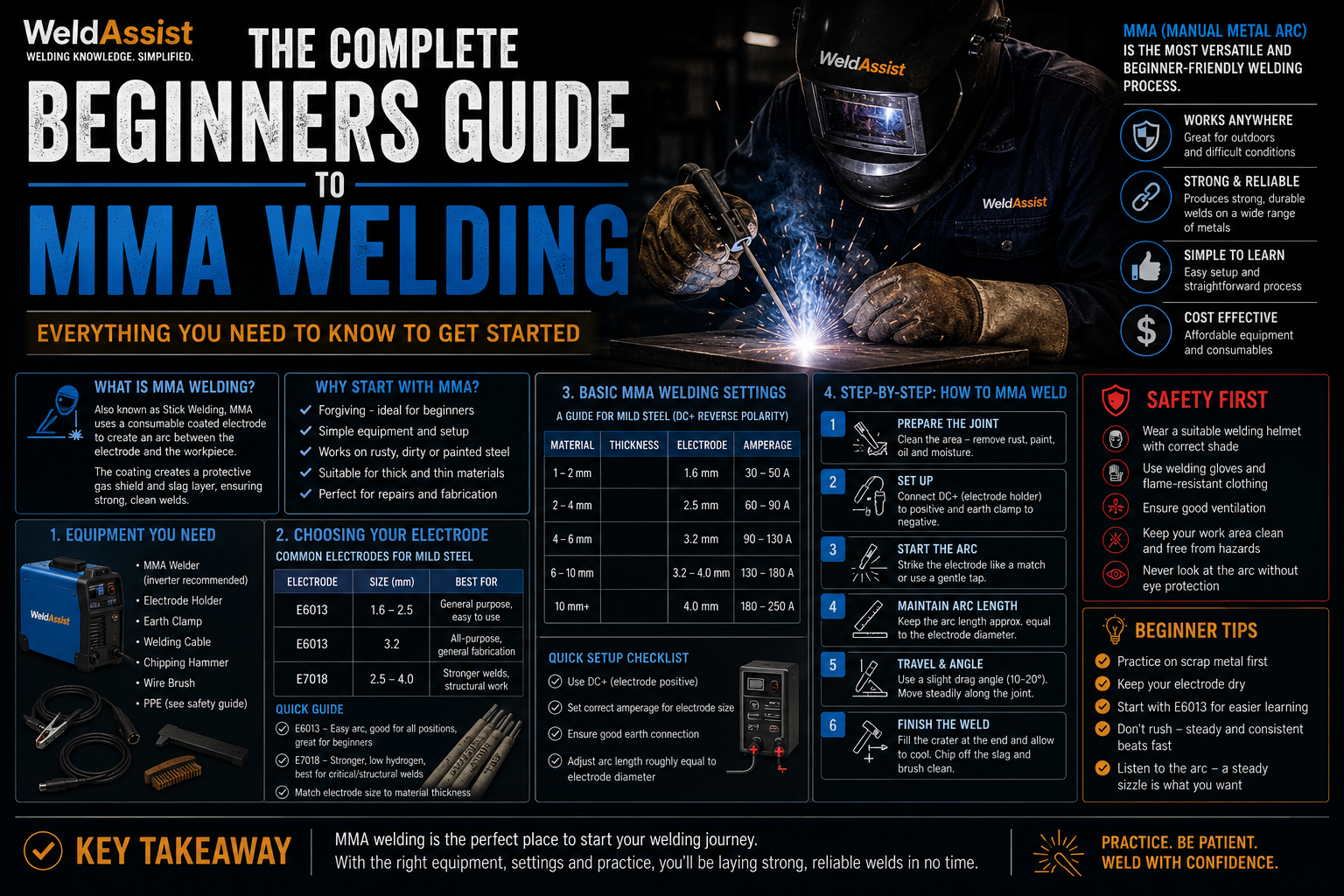
Everything You Need to Know to Start Welding Safely and Successfully

Metal Manual Arc (MMA) welding—also known as Stick welding or Shielded Metal Arc Welding (SMAW)—is one of the oldest, most reliable, and widely used welding processes in the world. Despite the rise of modern welding methods like MIG and TIG, MMA welding remains a favourite among professionals, farmers, fabricators, construction workers, maintenance engineers, and DIY enthusiasts.
Its simplicity, versatility, and ability to perform well in outdoor conditions make it an invaluable skill to learn.
Whether you’re completely new to welding or looking to understand the fundamentals before buying your first welder, this guide covers everything you need to know about MMA welding—from how it works to choosing electrodes, setting your machine, and producing quality welds.
What is MMA Welding?
MMA (Metal Manual Arc) welding is a manual arc welding process that joins metal using:
- An electric arc
- A consumable flux-coated electrode (commonly called a welding rod or stick)
- Heat generated by electrical current
When the electrode touches the workpiece and is then slightly lifted away, an electrical arc forms. This arc reaches temperatures of over 6,000°C, melting both the electrode and the base metal.
As the electrode melts, it deposits filler metal into the weld joint while the flux coating burns away, creating shielding gases and a protective slag layer that prevents contamination from oxygen, nitrogen, and moisture in the atmosphere.
Once the weld cools, the slag is chipped away to reveal the finished weld.
Why Choose MMA Welding?
There are several reasons why MMA welding has remained popular for decades.
Excellent Portability
Unlike MIG welding, MMA welders do not require gas cylinders.
This means you only need:
- A power source
- Welding leads
- Electrodes
Many inverter welders weigh under 6kg, making them ideal for mobile work.
Works Outdoors
Wind quickly blows shielding gas away from MIG welds.
Since MMA electrodes create their own shielding gas, stick welding performs exceptionally well outdoors in windy conditions.
This makes it the preferred choice for:
- Construction
- Agricultural repairs
- Structural steel
- Pipeline work
- Site maintenance
Handles Rust and Dirty Steel Better
Although clean metal is always best, MMA welding is far more forgiving than MIG.
It can successfully weld:
- Rusty steel
- Painted surfaces (after preparation)
- Galvanised steel (with appropriate safety precautions)
- Slightly contaminated material
Affordable Equipment
A good inverter MMA welder is often the least expensive way to start welding.
There are:
- Fewer accessories
- Lower running costs
- Minimal maintenance
How Does MMA Welding Work?
The process is surprisingly straightforward.
- The welder supplies electrical current.
- Current travels through the electrode holder.
- The electrode touches the metal.
- Pulling the rod back slightly creates an electric arc.
- The arc melts both materials.
- Molten metal forms a weld pool.
- Flux burns to protect the weld.
- Slag covers the cooling weld.
- Slag is removed after cooling.
Maintaining a consistent arc length is one of the most important skills a beginner learns.
Components of an MMA Welder
Every MMA setup includes several essential parts.
Power Source
Modern machines are usually inverter welders.
They offer:
- Stable arc characteristics
- Lightweight construction
- Lower power consumption
- Better efficiency
Older transformer welders still exist but are much heavier.
Electrode Holder
Often called the stinger, this clamps the electrode and carries current.
Earth Clamp
The return lead connects directly to the workpiece, completing the electrical circuit.
A poor earth connection causes:
- Difficult arc starts
- Unstable arc
- Excessive spatter
Welding Leads
Heavy-duty cables carry electrical current between the welder and the workpiece.
Damaged cables reduce welding performance and should be replaced.
Understanding Polarity
One of the first things beginners notice is the two output terminals on the welder.
These determine polarity.
DC Electrode Positive (DCEP)
Also called reverse polarity.
Common for many electrodes because it offers:
- Deeper penetration
- Stable arc
- Smooth bead profile
DC Electrode Negative (DCEN)
Sometimes preferred for:
- Thin material
- Certain specialist electrodes
Always follow the electrode manufacturer’s recommendation.
What Are Welding Electrodes?
Electrodes are consumable rods consisting of:
- Steel core wire
- Flux coating
The core becomes filler metal.
The coating provides:
- Shielding gas
- Arc stabilisers
- Alloying elements
- Slag formation
Different electrodes suit different applications.
Common Electrode Types
E6013
The most beginner-friendly electrode.
Best for:
- General fabrication
- Thin steel
- Home workshops
- Gates
- Trailers
- Garden equipment
Advantages:
- Easy to strike
- Smooth arc
- Attractive welds
- Easy slag removal
E7018
A low-hydrogen electrode widely used for structural work.
Provides:
- High-strength welds
- Excellent crack resistance
- Tough weld metal
Requires:
- Dry storage
- Better technique
E6010 / E6011
Designed for deep penetration.
Ideal for:
- Pipe welding
- Dirty steel
- Root passes
- Farm repairs
Produces a more aggressive arc than E6013.
Electrode Sizes
Larger rods require more current.
Typical guide:
| Electrode | Current Range |
|---|---|
| 1.6 mm | 25–45A |
| 2.0 mm | 40–70A |
| 2.5 mm | 70–100A |
| 3.2 mm | 90–130A |
| 4.0 mm | 130–180A |
| 5.0 mm | 180–240A |
These are starting points only—always check the manufacturer’s recommendations.
Choosing the Correct Amperage
Too little current causes:
- Rod sticking
- Poor penetration
- Irregular welds
Too much current causes:
- Excessive spatter
- Undercut
- Burn-through
- Overheated electrodes
A properly adjusted machine produces a smooth, consistent arc that sounds similar to frying bacon.
Preparing the Metal
Good preparation dramatically improves weld quality.
Remove:
- Heavy rust
- Paint
- Oil
- Grease
- Mill scale where practical
Use:
- Angle grinder
- Wire brush
- Flap disc
- Degreaser
Clean metal produces stronger, cleaner welds.
Joint Types
The joint determines weld strength.
Common joints include:
Butt Joint
Two plates joined edge to edge.
Used extensively in fabrication.
Lap Joint
One plate overlaps another.
Very common for thin steel.
T-Joint
Forms a “T” shape.
Often used in framework.
Corner Joint
Common in box section fabrication.
Basic Welding Positions
Flat (PA)
The easiest position for beginners.
Horizontal (PB)
Requires better puddle control.
Vertical (PF/PG)
One of the more difficult positions.
Requires slower movement.
Overhead (PE)
The most challenging position.
Molten metal naturally wants to fall, demanding excellent technique and appropriate protective clothing.
Striking an Arc
Beginners often struggle with starting.
Two common methods are:
Scratch Method
Similar to striking a match.
Tap Method
Tap the rod onto the metal before lifting slightly.
Maintaining Arc Length
The ideal arc length is roughly equal to the diameter of the electrode core.
Too long:
- Spatter
- Weak penetration
- Unstable arc
Too short:
- Electrode sticks
- Poor visibility
- Irregular bead
Travel Speed
Travel too slowly and you’ll create:
- Large welds
- Excessive heat
- Burn-through
Travel too quickly and you’ll see:
- Narrow welds
- Poor fusion
- Incomplete penetration
Aim for a consistent speed while watching the molten weld pool rather than the arc itself.
Electrode Angle
A general guideline is to hold the electrode at approximately 10–20° in the direction of travel (a drag angle for most electrodes).
Maintain a comfortable position so you can move steadily and keep the arc length consistent.
Understanding Slag
Slag protects the weld while cooling.
After cooling:
- Chip it away
- Wire brush the weld
- Inspect for defects
Never weld over slag.
It traps contamination.
Common Welding Defects
Porosity
Small holes caused by contamination or moisture.
Undercut
Grooves along the weld edges.
Usually caused by excessive current or travelling too quickly.
Lack of Fusion
Occurs when weld metal fails to bond properly.
Common causes include:
- Low amperage
- Incorrect angle
- Excessive travel speed
Slag Inclusions
Slag trapped inside the weld.
Often caused by poor cleaning between passes.
Cracking
Can result from:
- Rapid cooling
- Incorrect electrodes
- Hydrogen contamination
- Poor joint design
Essential Safety Equipment
Never weld without proper PPE.
Minimum equipment includes:
- Auto-darkening welding helmet (appropriate shade for the current used)
- Leather welding gloves
- Flame-resistant cotton or leather jacket
- Welding apron (optional but recommended)
- Leather boots
- Safety glasses for grinding and chipping slag
- Ear protection when grinding
- Respiratory protection where ventilation is insufficient or when welding materials that produce hazardous fumes
Avoid synthetic clothing, which can melt onto the skin when exposed to sparks.
Welding Safety Tips
Always:
- Work in a well-ventilated area.
- Keep flammable materials away from the work area.
- Inspect cables and equipment before use.
- Keep the work area dry.
- Ensure a good earth connection.
- Protect nearby people from arc flash using welding screens.
- Allow hot metal to cool before handling.
- Have a suitable fire extinguisher nearby and remain alert for smouldering materials after welding.
Beginner Practice Exercises
The fastest way to improve is through repetition.
Start with:
- Straight stringer beads.
- Parallel beads.
- Overlapping beads.
- Lap joints.
- Butt joints.
- Fillet welds on T-joints.
Focus on consistency before tackling more advanced positions.
Advantages of MMA Welding
- Inexpensive equipment
- Excellent portability
- Works outdoors
- No shielding gas required
- Handles thicker materials well
- Tolerates less-than-perfect surface conditions
- Suitable for maintenance and repair work
- Reliable in remote locations
Disadvantages of MMA Welding
- Slower than MIG for long production welds
- Electrodes must be replaced frequently
- Slag must be removed between passes
- Requires more practice to master
- Not ideal for very thin sheet metal
- Produces more spatter than some other processes
Tips for Better Welds
Success comes down to mastering a few fundamentals:
- Clean the metal thoroughly whenever possible.
- Choose the correct electrode for the job.
- Set the appropriate amperage.
- Keep a short, consistent arc.
- Watch the weld pool rather than the bright arc.
- Maintain a steady travel speed.
- Clean slag completely before additional passes.
- Practise regularly on scrap steel before attempting critical projects.
Final Thoughts
MMA (Stick) welding remains one of the most practical and versatile welding processes available. Its ability to produce strong welds without the need for shielding gas, combined with its portability and reliability in outdoor environments, ensures it continues to play a vital role in fabrication, repair, construction, and maintenance.
Like any hands-on skill, proficiency comes with practice. Early attempts may include uneven beads, occasional sticking electrodes, or inconsistent arc length, but these are all part of the learning process. By understanding the principles behind the arc, selecting the right electrode, preparing your material properly, and following safe working practices, you’ll build a solid foundation for producing strong, dependable welds.
Whether your goal is repairing farm machinery, fabricating workshop projects, or beginning a career in welding, mastering MMA welding is an excellent place to start. Once you’ve developed confidence with stick welding, the techniques you learn—such as controlling the weld pool, managing heat input, and maintaining consistent travel speed—will transfer readily to other welding processes, making MMA one of the best introductions to the wider world of welding.
Leave a Reply